
Rates Just Changed: Catch Contract Updates Before They Cost You a Sale
Resorts revise offers constantly. Miss one change and you lose margin — or the booking. Here's how change detection quietly protects you.
Resorts revise rates, offers, and surcharges all the time. When your system still holds the old numbers, you quote the wrong price. Here's how to catch contract drift before it costs you margin or the sale.
A resort emails you a new special offer on Monday. On Wednesday, you quote that same resort from the rate sheet you saved in March. The numbers don't match — and you don't notice. That small gap between what your system says and what the resort's latest contract actually says is where money quietly leaks out of your business.
This is the daily reality of rate change management. Resorts revise their offers constantly, and quotation accuracy depends on catching every one of those updates. This post is about contract drift detection — spotting the changes before they cost you a sale — and how to build that habit even before you buy any software.
Resorts change the deal more often than you think
A contract is not a one-time document. It is a living thing that a resort updates all year. In a single season you might receive:
- A new special offer (stay 4, pay 3).
- A stop-sell on certain dates.
- A new season with a fresh rate grid.
- A changed extra-night rate — 300 becomes 350.
- A new surcharge — a peak-period supplement, a green tax, a festive gala dinner that is now mandatory.
- An early-bird deadline that just moved forward two weeks.
Each of these arrives as an email, a PDF, or a WhatsApp message. None of them politely announce which field changed. That is the whole problem. As guides on hotel allotment contracts point out, suppliers can adjust rates and pull inventory with little notice — so the burden of tracking those changes lands on you.
When your numbers are stale, you lose either way
Here is why this matters in money terms. If your system holds the old numbers, you quote an old price. There is no safe direction to be wrong.
Quote too low, and you eat the difference. The resort raised the extra-night rate to 350, but you quoted 300. You are now honoring a price that costs you 50 per night out of your own margin.
Quote too high, and you lose the sale. Maybe the resort launched a "stay 4, pay 3" offer you never applied. Your competitor did apply it, came in cheaper, and won the booking.
This is not a small rounding problem. Pricing teams outside travel have measured it: analysts note that a single mispriced rate, multiplied across thousands of transactions, adds up to millions in lost revenue. In hotels specifically, price inconsistency is a known profit drain — rate disparity drives guests to cheaper channels and erodes trust in your quotes. The mechanism is different for a DMC, but the outcome is the same: wrong price, lost value.
Meet "drift" — the gap that grows while you're busy
Let's give this problem a plain name: drift.
Drift is the growing gap between what your system says and what the resort's latest contract actually says. On the day a resort sends a new offer, your saved numbers are already a little bit wrong. A week later, after two more resorts send updates, the gap is wider. Nobody made a mistake on any single day — the gap just accumulated while everyone was busy quoting.
The reason drift is so sneaky is that catching it by hand is genuinely hard. Opening a new PDF next to last month's version and comparing every cell — room types, seasons, extra-night rates, child ages, surcharges — is slow and easy to get wrong. Do it once and you might catch the change. Do it across forty resorts every week and something will slip.
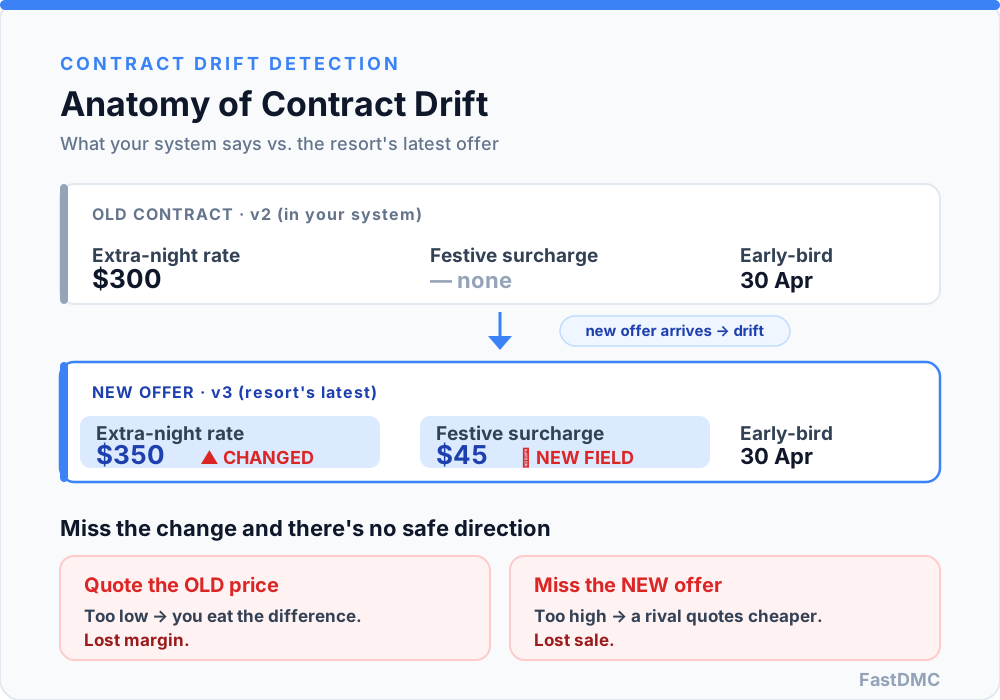
Anatomy of drift: one changed field and one new field are all it takes to quote too low (lost margin) or too high (lost sale).
Reduce drift even without special software
You do not need to buy anything to start closing the gap today. Most of this is habit and discipline.
Keep a single source of truth. One place where the current version of every resort contract lives — not four copies scattered across inboxes, a shared drive, and someone's desktop. Document-control experts consistently rank a single centralized source of truth as the foundation everything else sits on. If your team ever has to ask "which file is the latest?", drift is already winning.
Date and version every contract. Name files consistently: resort name, contract date, version number. "Palm Reef — 2026 Summer — v3" tells you instantly whether you are looking at the newest deal. A vague "Palm Reef rates final FINAL" does not.
Keep a simple change log. A one-line note each time a new offer lands: what changed, when, and who updated the system. It can be a spreadsheet tab. This tiny record is what lets you answer "when did this rate change?" without archaeology.
Build the noticing habit. When a new offer arrives, make it someone's job to write down exactly what is different before filing it. Not "new contract received" — but "extra-night rate 300 to 350, new festive surcharge added." That one sentence is the difference between a change you tracked and a change that drifted.
These habits mirror what the hotel side has learned about keeping rates consistent and updated across every channel: the win is not heroic effort, it is a reliable process where a rate is updated once and stays correct everywhere.
Where software quietly takes over
Habits get you far, but they still rely on a tired human comparing documents at 6 p.m. This is exactly the kind of tedious, high-stakes checking that software does better — and where a purpose-built tool earns its place.
When a fresh contract or offer arrives, the software reads it and compares it to the version you already had. Two things happen automatically:
- Drift detection. It flags every field that changed — a bumped extra-night rate, a moved early-bird deadline, a new stop-sell date — and shows you the old value next to the new one.
- New-field detection. When the resort introduces something you have never tracked before, like a brand-new surcharge, it surfaces that new field instead of silently dropping it. Silent drops are how surprise costs end up in your quotes.
FastDMC does exactly this. Contracts go in, changes come out highlighted, and a human approves them — so your prices stay aligned with the latest contract instead of last month's. The point is not to replace your judgment. It is to make sure no change ever reaches a customer's quote without someone seeing it first. As the broader rate parity playbook puts it: set the rate once, distribute it everywhere, and let the system catch the gaps.
The takeaway
Every resort offer you receive is a small chance to lose money — too low and you eat the margin, too high and you lose the booking. Drift is the slow accumulation of those chances. You can fight it today with one source of truth, dated versions, and a simple change log. And when the volume outgrows your evenings, drift detection and new-field detection let software watch the changes for you — so the price you quote is always the price the resort is actually offering.
Further reading
- The cost of pricing errors: preventing revenue leakage — Enable
- Hotel rate parity: what it is and how to manage it — SiteMinder
- Hotel rate parity issues and how to fix them — Mews
- Hotel rate parity: common issues and how to fix them — Lighthouse
- Document version control best practices — Ideagen
- Hotel allotment contracts: an agent's guide to better terms — DMC Quote