
From Spreadsheets and WhatsApp to a Workflow That Actually Scales
Most operations run on Google Sheets, chat, and memory. Here's a simple, practical path to getting organized — starting with a single board.
Google Sheets, WhatsApp, and a good memory can only carry your operation so far. Here's a simple, non-technical first step toward inquiry management that scales: one shared ticketing board everyone can see.
An inquiry lands in your inbox on a Tuesday morning. You copy the dates into a Google Sheet, ping a colleague on WhatsApp to check resort availability, and dig through Google Drive for last month's rate sheet. By Thursday, nobody is quite sure who is handling it or whether the agency ever got a reply.
If that sounds familiar, you are not doing anything wrong. Almost every operation starts here. The problem is not effort — it is that your workflow lives in three different apps and one person's head. This post is about a simple, practical path to getting organized, and a first step you can take today without buying a single piece of software.
The tools you already use — and where they run out
Most teams run on what we could call semi-tooling. Google Drive holds the files. WhatsApp holds the conversations. Google Sheets or Excel holds the tracking. Some teams even build itinerary and price calculations inside a spreadsheet, formula by formula.
These tools are not bad. They are free, familiar, and they got you this far. But they were never built to run an operation. Spreadsheets in particular hide a surprising amount of risk: one widely reported study found that 94% of business spreadsheets contain critical errors, often because people build them without any formal training. Oracle's own breakdown of common spreadsheet risks points to the same weak spots: broken formulas, version confusion, and no clear owner.
When your quotes and pricing depend on a shared sheet, one wrong cell can send an agency a rate that costs you money.
Pricing lives in people's heads, not your systems
Here is the deeper issue. Much of what makes your operation good is tacit knowledge — the unwritten expertise that lives in your most experienced staff. They know which resorts suit a honeymoon versus a family of five. They know why a split stay across two islands needs a transfer buffer. They know how to price a stay by feel, and they still reach for a calculator to be sure.
That knowledge is gold. It is also fragile. As one clear explainer on tacit knowledge puts it, this kind of expertise is hard to write down and it walks out the door when a key person leaves. Every new hire has to be trained on it slowly, one inquiry at a time.
So when an inquiry arrives, whoever picks it up has to manually search for suitable resorts, recommend options to the agency, and then handle changes that arrive in cycles as traveler feedback comes back. Each round means more searching, more recalculating, more messages. It is heavy, and it is slow.
The simple next step: one shared board
You do not need to fix all of that at once. The single most useful thing you can do is get organized around one shared board — a ticketing or task board where every inquiry becomes a card that everyone can see.
Think of it like a kitchen order rail. Every ticket is visible, every ticket has a stage, and anyone walking past can see what is cooking and what is stuck. As Atlassian explains in its guide to kanban boards, the whole point is to make work visible so a team can spot bottlenecks and coordinate without endless status calls. Miro's overview of kanban makes the same point: seeing the work is what lets a team manage it.
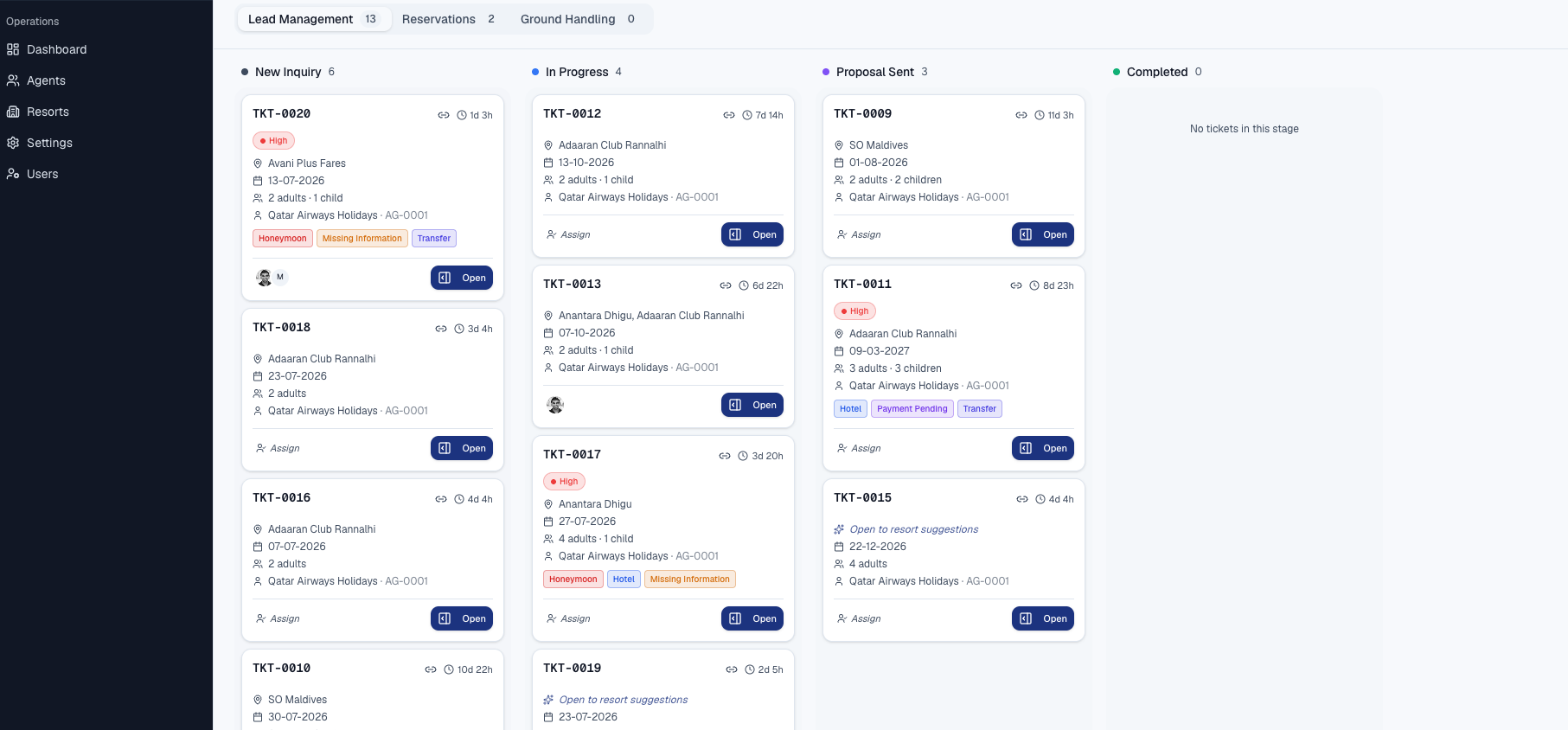
A shared board turns scattered inquiries into one clear picture of who is doing what.
Here is the maturity path most operations follow. You do not skip steps — you climb them.
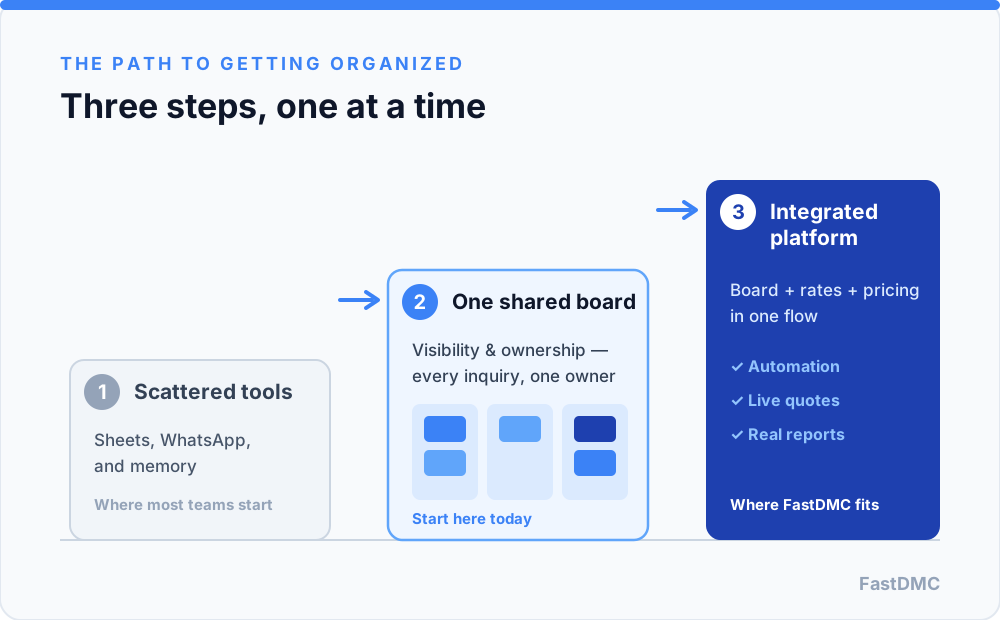
Step one is simply making the work visible. Everything else builds on that.
What a board gives you right away
A board is not just tidier. It changes how the team works, from day one:
- Visibility. Anyone can glance at the board and see every open inquiry, its stage, and any critical flags — a tight deadline, a VIP guest, a pending payment.
- Accountability. Each inquiry has one clear owner. No more "I thought you were handling that."
- Reporting later. Once work flows through one place, you can start to see patterns: how many inquiries you handle a week, how long a quote takes, where things stall.
That is step one, and it is enough to make a real difference. Spreadsheets simply cannot do this well, which is why teams tend to outgrow them once coordination matters more than tracking.
Best practices for any board — even without new software
You can set this up in any free tool you already trust. The habits matter more than the brand. Keep it approachable:
| Do this | Why it helps |
|---|---|
| Columns for each stage | See at a glance where every inquiry sits: New, Researching, Quoted, Changes, Confirmed |
| Labels for priority and deadlines | Spot the urgent and the high-value cards instantly |
| One owner per inquiry | Nothing falls through the cracks between people |
| A shared place for resort info | Rates and notes live once, not in ten chat threads |
That last point is where you start turning tacit knowledge into something the whole team can use. When resort details and pricing notes live in a shared, agreed place instead of one person's memory, training gets faster and mistakes get rarer. This is the same logic behind standard operating procedures: write the important things down so the business does not depend on any single person.
Where a purpose-built platform fits
Once a board becomes second nature, you will feel the next limit. Your board still does not know your rates. It cannot price a stay or update a quote when a traveler changes their dates. You are still copying numbers between tools.
That is the moment to think about integrating your tools — or moving to a platform built for this work. FastDMC brings the board, your resort rates, and your pricing into one place, so an inquiry, a quote, and a change all live in the same flow. The visibility you built by hand becomes automatic, and the reports come for free.
But you do not have to start there. Start with the board.
The takeaway
Google Sheets, WhatsApp, and a sharp memory are a fine place to begin — and a hard place to grow. You do not need to rebuild everything overnight. Put every inquiry on one shared board, give each a single owner, and make the work visible. That one step buys you clarity today and sets you up for automation and real reporting tomorrow. When you are ready, a tool like FastDMC picks up where the board leaves off.
Further reading
- Study finds 94% of business spreadsheets have critical errors — Phys.org
- 10 common spreadsheet risks for businesses — Oracle
- What is a kanban board? — Atlassian
- What is a kanban board and how to use one — Miro
- What is tacit knowledge: importance, benefits and examples — Document360
- Standard operating procedures and why they matter — American Express