
How AI Can Actually Automate the Work Inside Your Operation
From reading contracts to calculating split-stay prices to drafting replies — a grounded tour of what AI can do today, and where it's heading.
A practical tour of AI automation inside a DMC reading contracts, calculating prices, searching resorts, recommending options, and drafting replies and how it fits around the people who run the show.
An inquiry lands in your inbox at 9 a.m. By the time you send a quote, you have opened four contract PDFs, checked which rates apply, done the math on a split stay across two resorts, added a transfer, and written a friendly reply. That is an hour of skilled work for one email and twenty more emails are waiting.
This is where AI automation earns its place. Not as a robot that replaces you, but as a fast assistant that handles the reading, the math, and the first draft so your team can focus on the parts that need judgment. Let's take a grounded tour of what AI can actually do inside a DMC operation today. Few examples include Contract automation, AI price calculation, resort price search, option recommendation, and conversational AI and where it is heading.
Start with the workflow, not the robot
The biggest mistake is to imagine AI as a magic box you dump everything into. A better mental model is simpler: keep a structured workflow for people, and put a flexible AI assistant next to it.
Think of a task board where one card per inquiry, moving from "New" to "Quoted" to "Confirmed." That board is the organized backbone your team already trusts. The AI works off to the side, unstructured and flexible, able to touch any step. But its results always land back in the tidy board, where a human can check them or edit them by hand.
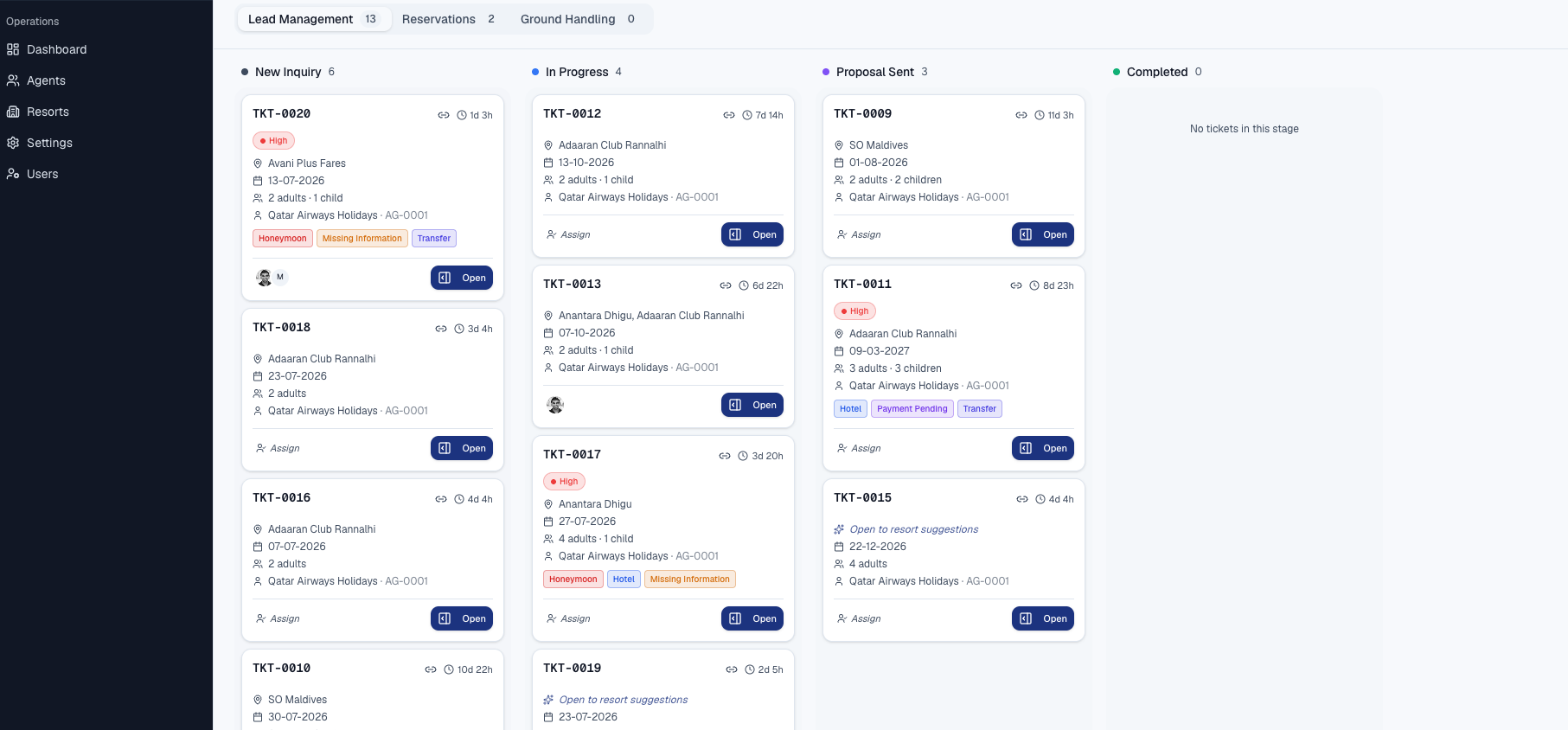 Your task board is the structured home base every inquiry has a card, and AI results land back here for review.
That balance matters. McKinsey's research on travel finds AI works best when it takes over repetitive tasks and frees people for higher-value work, not when it tries to run the whole show unattended (McKinsey on AI in travel). Structure for people. Flexibility for the AI. Both, together.
Reading contracts into clean data
Every rate you quote starts in a contract usually a PDF that no two resorts format the same way. Someone on your team reads it and types the numbers into your system. It is slow, and a mistyped rate becomes a mispriced quote.
Modern AI is genuinely good at this. Large language models can read messy documents and pull out structured fields room types, seasons, rates, minimum stays turning a page of prose into rows you can use. IBM describes this as information extraction: the AI understands context, so it finds the right number even when every contract is laid out differently.
Two nearby tricks make this even more useful:
- Drift detection. When a resort sends a new version of a contract, AI can compare it to the old one and flag exactly what changed. A rate bumped, a blackout date added so nothing slips past you.
- New field detection. When a contract introduces something you have never tracked before, like a new surcharge or a green tax, AI can spot the new field and surface it instead of silently dropping it.
FastDMC already does this: contracts go in, structured data comes out, and changes get flagged for a human to approve.
Doing the math including the hard cases
Once rates are in, pricing is arithmetic but arithmetic with a hundred edge cases. AI price calculation shines on the ones that eat your afternoon.
Take a split stay: three nights at one resort, four at another, crossing a season change halfway through, with a child rate and a meal plan on one leg only. That split calculation is exactly the kind of multi-step logic that is easy to get wrong by hand and easy to automate reliably.
The same goes for transfer costs. A speedboat or car transfer often prices by distance or zone. AI can calculate the transfer for a given route automatically and drop it into the quote, instead of you looking it up on a chart every time.
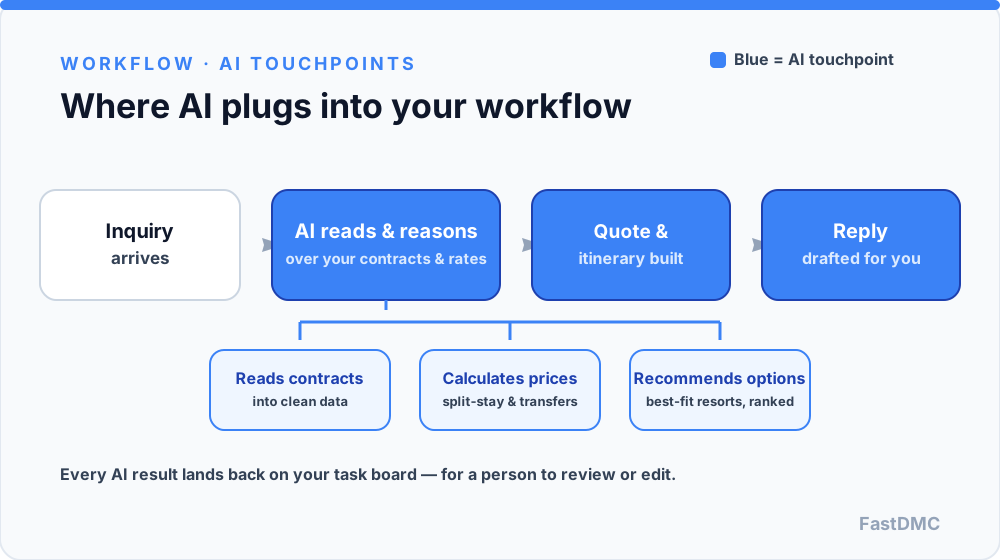 AI touchpoints (in blue) sit along the same path your inquiry already travels including reading, calculating, recommending, drafting.
Searching resorts and recommending the best fit
An inquiry rarely names a resort. It says "honeymoon, over-water villa, under $4,000, first week of August." Answering that means searching across many resorts and rate sheets to see what fits.
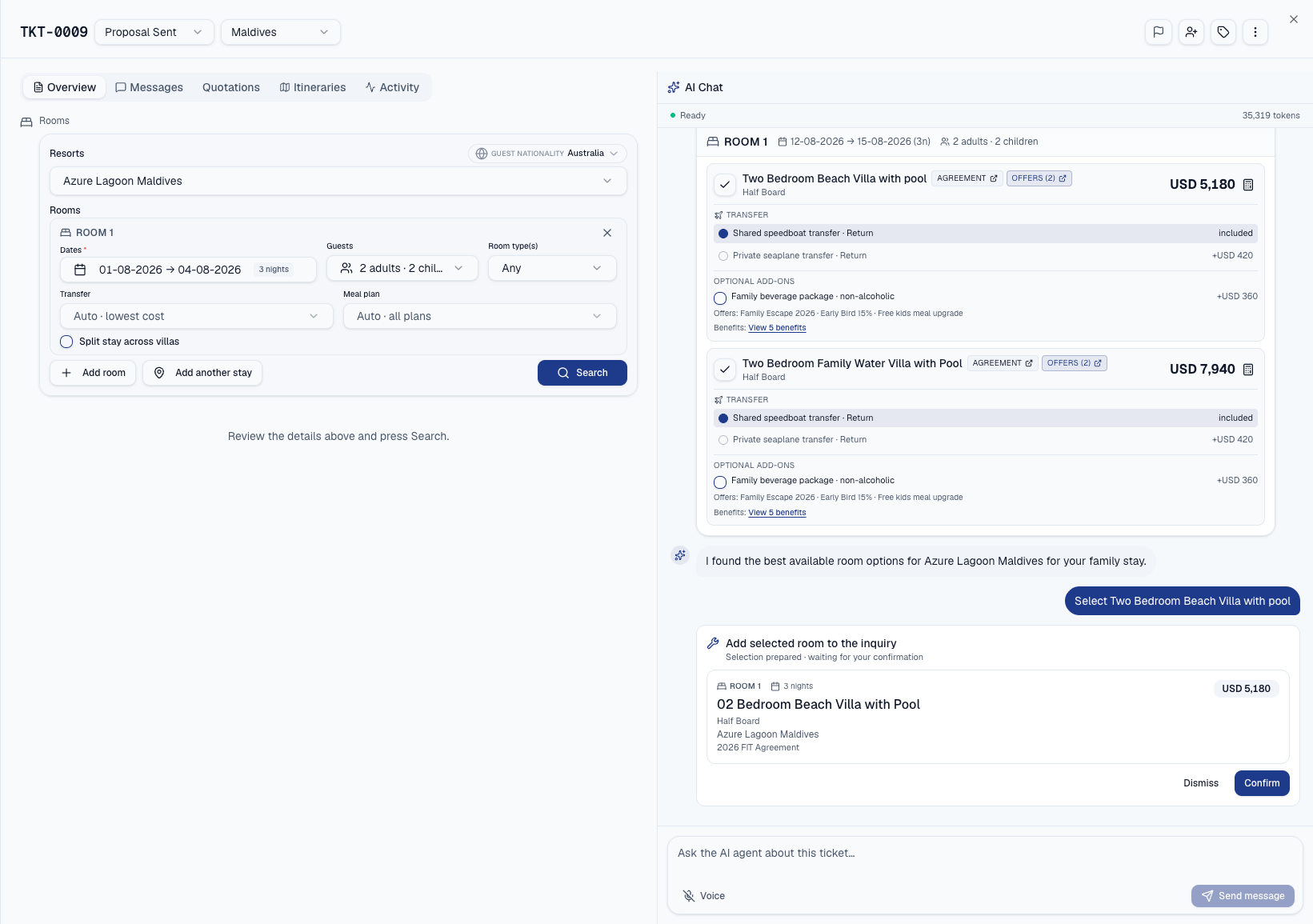
This is a strong use for AI-powered resort price search: instead of you opening files one by one, the AI searches your priced inventory and returns the options that match the dates, budget, and style.
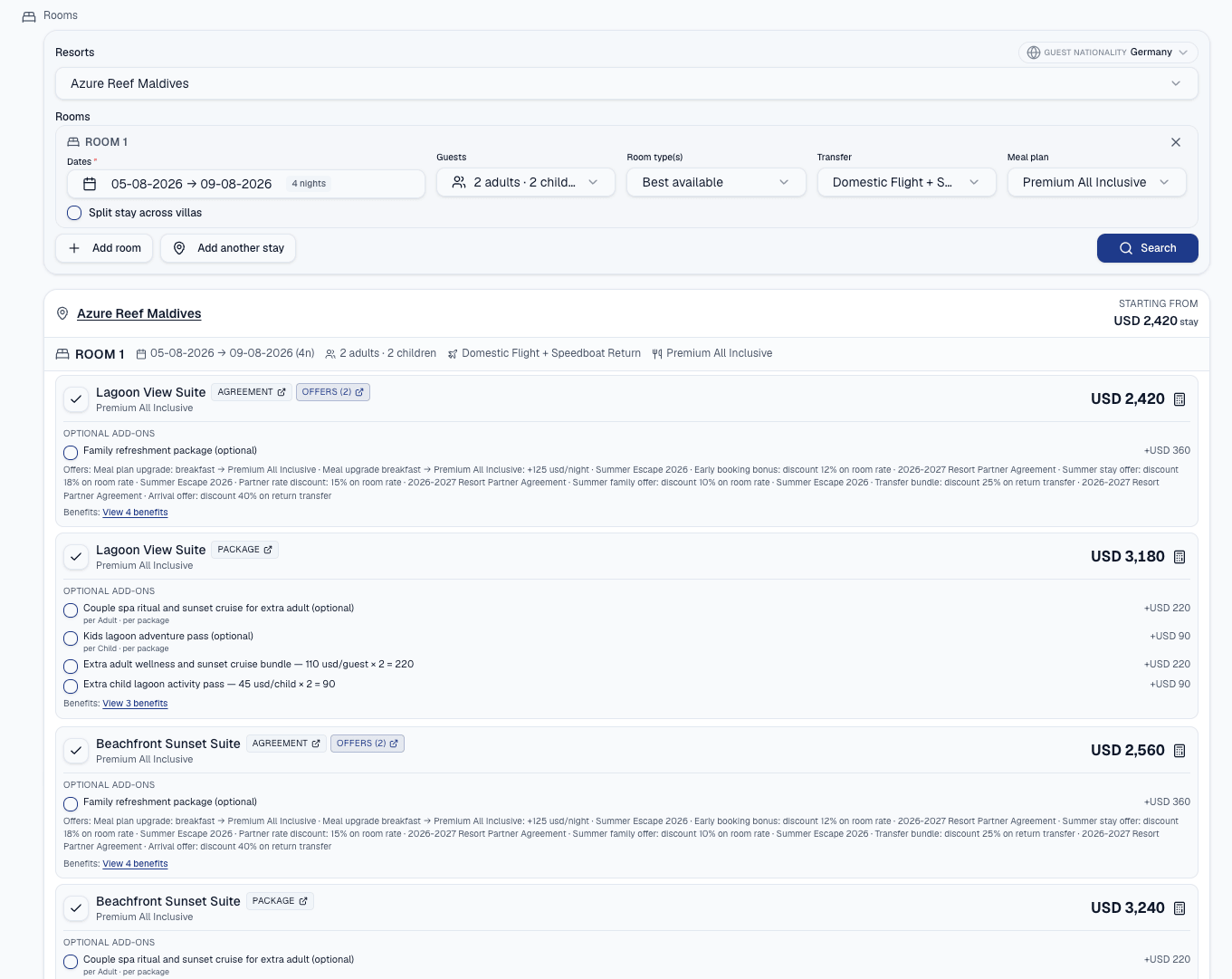 Ask in plain terms; get back the resorts that actually fit the dates, budget, and style.
Option recommendation goes one step further. Rather than a raw list, the AI can surface the two or three best-fit resorts for that specific inquiry where the ones most likely to win the booking with the reasoning shown so you stay in control of the final pick.
Turning a message into a structured entry
Here is where conversational AI quietly saves the most time. A travel agency sends you a loose message: "2 adults 1 child, 20–27 Aug, half board, need airport pickup, budget around 3k."
Drop that message into the assistant, and it reads the free text and creates a clean, structured entry in your system where dates, pax, board basis, transfer, budget are ready on the board. No retyping. This natural-language-to-structured-data step is exactly what conversational travel tools are being built around across the industry (PhocusWire's 2025 AI roundup).
 Paste an agency's messy message; the assistant turns it into a structured inquiry you can act on.
Drafting the reply and building the quote
With the pieces in place, AI can draft the response, a warm, clear reply with the options and prices for you to review and send. You edit the tone, add a personal note, and hit send in a fraction of the usual time.
The same automation extends to the full quotation and itinerary. Quotation automation assembles the priced options; itinerary automation lays out the day-by-day plan, transfers included. Under the hood, this often uses retrieval-augmented generation where the AI pulls from your real rates and rules first, then writes, so the numbers are grounded in your data rather than guessed.
What to do even without software
You can start capturing the value today:
- Write down your pricing rules. Season dates, child ages, split-stay logic, transfer zones. Clear rules are what any AI (or new hire) needs to be accurate.
- Keep one source of truth for current contracts, so drift is easy to spot.
- Standardize your inquiry intake, even a simple form such that messages arrive in a shape that is easy to structure.
- Start with one step, like contract reading or transfer math, and check every output before you trust it.
Momentum is real: venture funding for AI-enabled travel startups jumped from about 10% of the sector's investment in 2023 to 45% by mid-2025, and the majority of travel companies are now experimenting with these tools (McKinsey, remapping travel with agentic AI; Skift on AI adoption).
Where FastDMC fits
FastDMC is built around exactly this shape: a structured task board for your team, with an AI assistant on the side. It already reads contracts into data, detects drift and new fields, runs split-stay and transfer price calculations, searches resorts, recommends options, and drafts replies and every result lands back on the board for a human to check.
The point is not to remove your judgment. It is to hand you clean data, correct math, and a solid first draft, so the hour-per-email work becomes minutes and your people spend their time where relationships and taste actually matter.
Further reading
- The promise of travel in the age of AI — McKinsey
- Remapping travel with agentic AI — McKinsey
- A snapshot of AI developments in travel in 2025 — PhocusWire
- AI in corporate travel: finding the right fit — Skift
- What is information extraction? — IBM
- What is retrieval-augmented generation (RAG)? — Google Cloud