
Stop Treating Every Quote Like an Exam
Pricing from memory and a calculator is exhausting and easy to get wrong. Here's how efficient operations free their people for the work that actually grows the business.
Pricing every stay from memory and a calculator drains your best people and invites costly mistakes. Here's how pricing automation frees that energy for quote accuracy, ground handling, and the work that grows the business.
An inquiry lands. Someone on your team opens the contract, reaches for a calculator, and starts working the numbers — season dates, meal plan, child rate, transfer. It feels like sitting an exam. And a new exam arrives with every single email.
You should not have to spend an hour on price calculation just to get one quote right. But that is the daily reality for a lot of operations, and it quietly taxes your best people. This post is about efficiency — not doing less, but spending your team's energy where it grows the business: quote accuracy, better inquiry handling, and stronger service on the ground.
The quiet cost of pricing from your head
Watch how a quote actually gets made and you will see two modes, both stressful.
Sometimes your staffer answers from memory. They know the resort, they roughly know the season, so they fire back a number. Fast — but a guess. Sometimes they slow down, open the agreement, and reach for the calculator to be sure. Accurate — but it eats twenty minutes, and twenty more inquiries are waiting.
Either way it is cognitively heavy. Every quote is a fresh set of small decisions with no room for error, and that adds up.
Why the pressure is real, not imagined
This is not weakness. It is how brains work. Making choice after choice all day leads to decision fatigue — the well-documented drop in judgment quality after a long run of decisions. The tenth quote of the afternoon simply gets less careful attention than the first.
The numbers back this up. Manual data entry and hand calculation carry an error rate of roughly 1 to 4 percent per field, and that climbs as the day wears on and the work gets more complex. A split stay across two resorts and a season change has a dozen fields. One slip and you have quoted a price you cannot honor — or one that quietly loses you money.
And the cost is not only the mistake. It is the mental toll of trying not to make one, all day, every day.
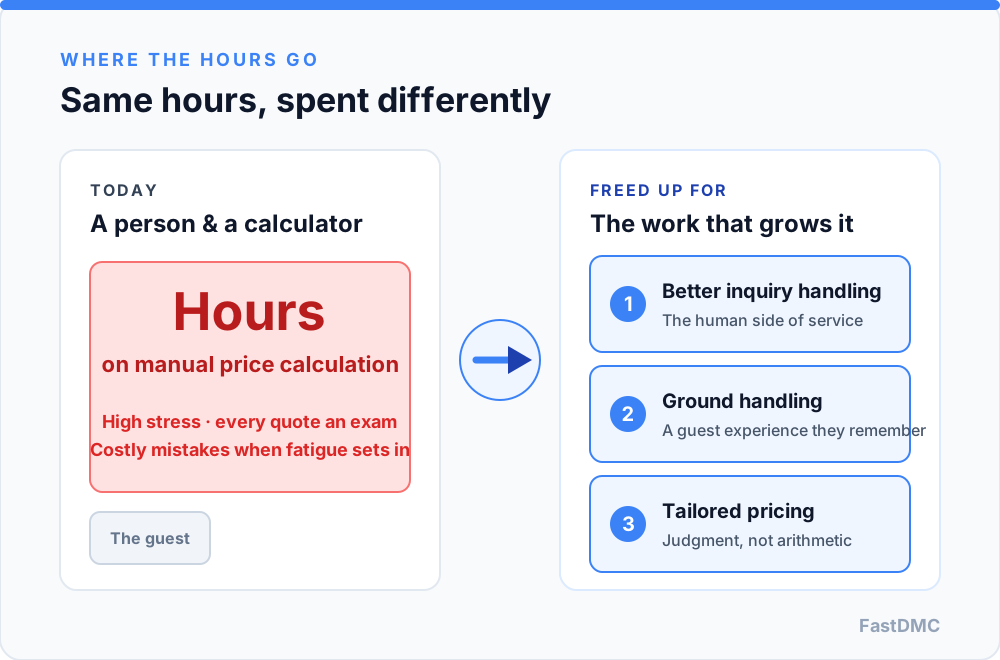
The same hours, spent differently: less time on the calculator, more on the work that grows the business.
The shift: let the math be the machine's job
Here is the freeing idea. Pricing is arithmetic, and arithmetic is exactly what software is good at. The rates live in the contract. The rules — seasons, child rates, meal plans, transfers — are fixed. A tool can apply them the same way at 9 a.m. and at 5 p.m., without tiring and without guessing.
This is the heart of pricing automation. You load your agreements once, and the quote is calculated for you, correctly, every time. Your staffer stops sitting the exam and starts checking a result they can trust.
That is the pattern McKinsey describes across industries: automation works best when it takes over repetitive tasks and frees people for higher-value work. The goal is not fewer people. It is your good people, unclogged.
What the freed-up time actually unlocks
This is the part worth getting excited about. When the calculator stops owning your team's afternoon, that energy goes back into the work only people can do well.
Better inquiry handling. A quote is a conversation, not a number. When your staffer is not buried in arithmetic, they can read what the guest really wants, ask the smart follow-up, and reply like a human. That matters: emotionally connected customers are far more valuable than merely satisfied ones — and connection comes from attention, which manual pricing steals.
Higher-quality service on the ground. Ground handling and the guest experience are where your reputation is actually made — the transfer that runs on time, the special occasion someone remembered, the problem solved before the guest notices it. Those things need present, unhurried people, not staff frazzled from a morning of quotes.
More tailored pricing. With the base math handled, your team has room to think. Should this repeat agent get a sharper rate? Does this honeymoon deserve a thoughtful add-on? Tailored pricing is judgment work, and judgment is what you free up when the routine calculation runs itself.
Here is the same day, before and after:
| The day today | The day after automation |
|---|---|
| Hours on manual price calculation | Minutes to review a calculated quote |
| Answering from memory, hoping it's right | Answering with confidence |
| Mistakes that cost money and trust | Consistent, accurate quotes |
| Little time for the guest | Time for service and relationships |
You can start improving this today
You do not need to buy anything to reduce the strain. A few practical moves help right away:
- Write the rules down. Turn "we usually charge…" into a clear, shared rate sheet so pricing does not live only in one person's head.
- Make templates for the common cases. A honeymoon week, a family of four, a standard transfer — pre-work the ones you quote most.
- Batch the hard quotes. Do the heavy split-stay calculations when your team is fresh, not at 4 p.m. when fatigue peaks.
- Double-check the money-losing errors, not every keystroke. Focus review where a mistake actually hurts.
These reduce the load. But they do not remove it — a person is still doing the math.
Where a purpose-built tool fits
This is the gap FastDMC is built to close. Your contracts go in, and quotes come out calculated — split stays, season changes, transfers, child rates, all handled the same reliable way every time. The exam feeling goes away because the arithmetic is no longer a test your team has to pass on every email.
What is left for your people is the good part: reading the inquiry well, pricing it thoughtfully, and delivering a stay the guest remembers. That is not a smaller job. It is the job that grows the business.
The takeaway
Efficiency is not about squeezing your team to do more. It is about spending their best energy where it counts. Let the software carry the calculation, and give your people back the hours — and the focus — for quote accuracy, real customer service, and the human work that no calculator will ever do.
Further reading
- Decision fatigue — how decision quality drops after a long run of choices.
- Data Entry Error Rates: How Much Manual Mistakes Really Cost — typical error rates for manual data entry and calculation.
- The Promise of Travel in the Age of AI — McKinsey on automation freeing people for higher-value work.
- An Emotional Connection Matters More Than Customer Satisfaction — why attention and connection drive customer value.
- The New Science of Customer Emotions — the business impact of emotionally connected customers.