
The Hidden Math Behind Every Transfer Quote
Distance, seaplane vs. speedboat, timing, and group size — transfers quietly break quotes. Here's how to price them fast and consistently.
A quote is never just room plus package. Getting the guest there and back is where numbers quietly go wrong. Here's the hidden math behind transfer cost calculation — and how to price every leg fast and consistently.

An agency asks for a quote: seven nights, two adults and a child, a beach villa on an island 90 minutes from the airport. You have the room rate. You have the package. You send the number. Then, two emails later, the transfer cost catches up with you — and the total you promised no longer holds.
This is where quotes quietly go wrong. A quote is never just room plus package. It is also getting the guest there and back, and that leg carries its own hidden math. Transfer cost calculation looks simple until you actually do it, and the more you rely on memory, the more often two staff quote two different totals for the same trip.
Why the transfer leg is where quotes break
The room rate is easy. It is printed on the contract. The transfer is not one number — it is a small equation that changes with almost every inquiry.
A seaplane transfer and a speedboat transfer to the very same resort can differ by hundreds of dollars per person. As The Points Guy notes in its guide to Maldives transfer fees, speedboats are generally cheaper than seaplanes, but the price does not track neatly with distance — the resort sets it, so you cannot just eyeball it. Get the mode wrong and your margin walks out the door.
That matters more than it sounds. In online travel, surprise costs are the fastest way to lose a booking. Baymard's long-running checkout research finds that "extra costs too high" has been the number one reason people abandon a cart for years running. Contentsquare's work on travel booking abandonment says the same thing in plainer terms: a fee that shows up late feels like deception, and the traveler leaves. A wrong transfer number is exactly that kind of late surprise.
The factors that quietly move the price
Here is what actually goes into a transfer price. None of it is hard on its own. The trouble is that it all stacks, and it stacks differently for every trip.
- Mode. Speedboat, seaplane, domestic flight, or a private car each has its own rate — and its own rules.
- Distance from the airport. Nearer islands are cheaper and faster; far-flung resorts cost more and sometimes need a flight plus a boat.
- Time of day. Late arrivals can trigger a night or after-hours surcharge. Seaplanes only fly in daylight, so a late flight can force an airport-hotel night that lands on your quote too.
- Group size. Shared transfers are per person; private ones are per boat. The break-even point shifts as the group grows.
- Child vs. adult rates. Children usually get a discount. Local Maldives transfer rate guides show children aged 2–11 often paying 30–40% less, with infants free.
- Return legs. Almost every transfer is round trip. Forget the return and you have halved a real cost.
- Split-stay connections. Two resorts in one trip means a resort-to-resort transfer in the middle — a leg that is easy to miss entirely.
This is not so different from how freight and logistics teams price a route. As project44 explains in its primer on dynamic pricing in logistics, distance-based pricing is only one input among many — capacity, timing, and service level all move the final number. Your transfers work the same way. Distance is the start of the calculation, not the end of it.
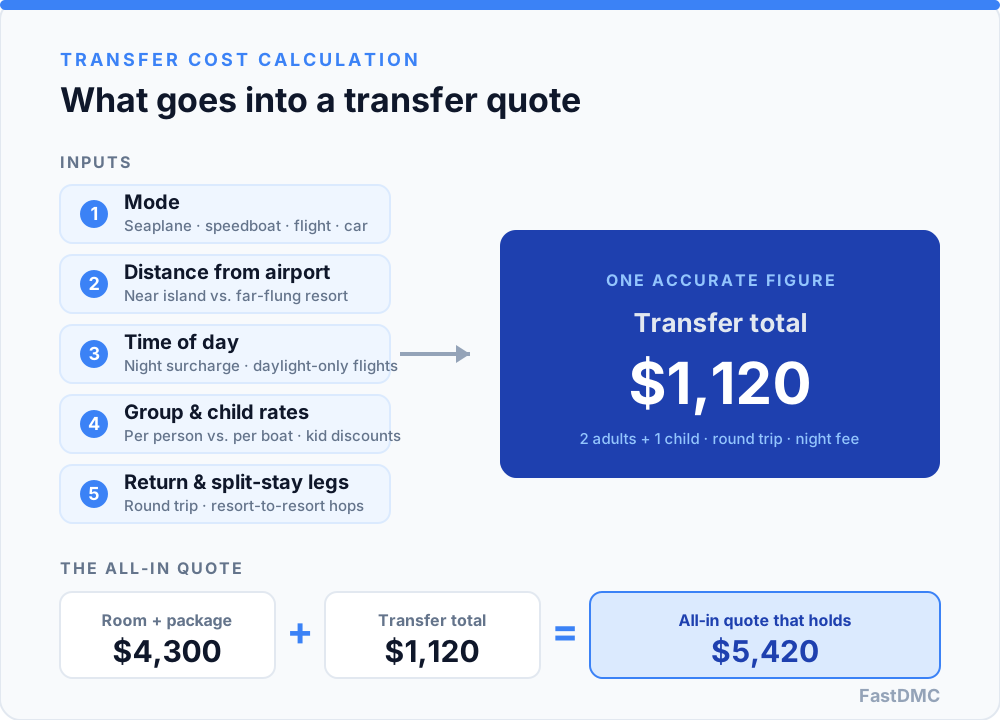
Every input on the left changes the transfer total. Miss one, and the quote is wrong before it leaves your outbox.
A small worked example
Picture that same family: two adults and one child (age 8), seven nights, a resort 90 minutes out by speedboat. Say the shared speedboat is $200 per adult one way. Walk the math the way a careful staffer would.
- Two adults, one way: 2 × $200 = $400
- One child at a 35% discount, one way: $200 × 0.65 = $130
- One-way subtotal: $530
- Return leg (double it): $1,060
- Flight lands at 8:40 p.m., so an after-hours surcharge applies: +$60
- Transfer total: $1,120
Now add that to the room and package, and you have an honest all-in quote. Skip the return leg and you are $530 short. Forget the child rate and you have overcharged a family that will notice. Miss the night surcharge and you eat it. Every one of those slips is common when the sum lives in someone's head.
Best practice, even without any software
You can tighten this up today, with nothing more than a shared document and a habit. The goal is simple: the same trip should produce the same transfer total no matter who quotes it.
- Keep a transfer rate sheet per resort and per mode. One row for speedboat, one for seaplane, one for domestic flight, with adult and child rates side by side.
- Write down the surcharge rules. Night cut-off times, after-hours fees, and the daylight window for seaplanes. Put the rule next to the rate so nobody has to remember it.
- Use a transfer checklist for every quote. Mode chosen? Return leg included? Child rates applied? Group size priced right? Split-stay connection added? Five ticks, no missed legs.
These habits are the same discipline that keeps a rate sheet honest. They will not make the math instant, but they will make it consistent — and consistency is what protects both your margin and your reputation with agencies.
Where automation picks up the slack
A rate sheet and a checklist stop the worst errors. They do not make the work fast. Every inquiry still means looking up rates, applying discounts, doubling the legs, and adding surcharges by hand — and every change from the traveler means doing it all again.
This is the point where purpose-built quotation automation earns its keep. Automated tools cut real time here: one industry review of DMC software solutions found semi-automated quoting can trim processing time by around 40%. FastDMC goes a step further by combining distance-based transfer cost calculation with full itinerary pricing, so the room, the package, and every transfer leg — including split-stay connections and return trips — roll into one accurate quote automatically. Change the dates or the group, and the transfer math recalculates itself.
The result is the thing you actually want: the same trip quotes the same total, every time, in seconds instead of emails.
The takeaway
The transfer leg is small on the page and large in the damage it can do. Mode, distance, timing, group size, child rates, return legs, and split-stay connections all move the number, and doing that math from memory is how good quotes quietly go wrong. Build a clear rate sheet, write the surcharge rules down, and run a checklist so no leg is missed. When you are ready to make it fast as well as consistent, a tool like FastDMC folds the whole transfer calculation into the quote for you — so the number you send is the number that holds.
Further reading
- Your ultimate guide to seaplane and speedboat transfer fees in the Maldives — The Points Guy
- Maldives transfer costs: seaplane, speedboat and domestic flight rates — IM Maldives
- What is dynamic pricing in freight and logistics? — project44
- How to reduce cart abandonment (data-backed strategies) — Baymard Institute
- Why customers abandon travel bookings — Contentsquare
- Top 5 software solutions for DMCs — Odys