
Can You Use ChatGPT for Price Calculation? Yes! But Read This First
ChatGPT will happily price a contract for you. Here's why the number can be quietly wrong, and how a purpose-built AI avoids the trap.
ChatGPT can price a contract in seconds, and the answer looks convincing. But general chatbots guess at arithmetic. Here's why the number can be wrong, and how a hybrid AI fixes it.
When people say "AI" today, they usually mean ChatGPT or a chatbot like it. So it is a fair question to ask about ChatGPT price calculation: can you just paste in a resort contract and let it quote the stay? You can try it right now, and the answer it gives will look impressive. The problem is that "looks right" and "is right" are not the same thing.
This matters because a wrong number in a quote is not a small mistake. Quote too high and you lose the booking. Quote too low and you eat the difference out of your own margin. So before you trust a chatbot with a price a customer will actually pay, it helps to understand what these tools are genuinely good at, and where they quietly fall down.
What a chatbot is actually great at
General chatbots are a real gift for the writing side of your day. Drafting a friendly reply to an agency, turning a long email chain into three clear bullet points, brainstorming a subject line for a promo, tidying up an itinerary description so it reads well. This is where they shine, because language is exactly what they were built for.
So this is not an "AI is bad" article. Used for the right jobs, a chatbot can save your team real time every single day. The trouble starts when you hand it a job it was never designed to do.
Why the pricing number can be quietly wrong
To see the risk, it helps to know how a large language model (LLM) works under the hood. In plain terms, it predicts the next likely word based on patterns it saw in huge amounts of text. As IBM explains in its overview of LLMs, the model does not know the answer in advance; it makes a best guess at each step and strings those guesses together.
That is a powerful trick for producing text that sounds right. But notice what it is doing: it is producing plausible-sounding words, not carefully doing exact arithmetic step by step. When it "calculates" a price, it is really pattern-matching its way to a number that looks reasonable.
That is also why chatbots sometimes state things with total confidence that simply are not true. The industry calls this a hallucination, which Google Cloud describes as output that appears plausible while being fabricated or inaccurate. IBM's explainer on AI hallucinations and the Wikipedia entry on the topic both make the same point: the text can be wrong and still sound completely certain.
Math makes this worse. A study on mathematical reasoning in LLMs found that while models do fine on isolated sums, their accuracy drops sharply once the numbers are buried inside a real-world problem with several conditions to juggle. That is precisely your world: seasons, per-night rates, child policies, minimum stays, stop-sells, and a stay that straddles two rate periods. The more rules that have to combine, the more room there is for a confident wrong answer.
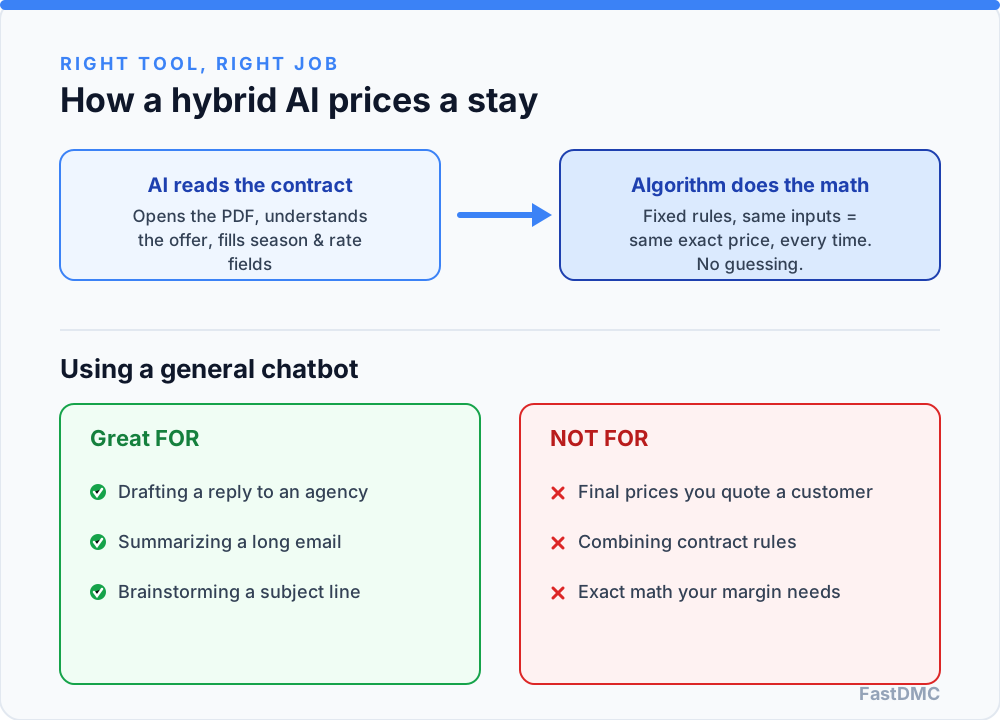
The safe pattern: let AI do the reading, let a fixed algorithm do the math.
The fix: let each tool do what it is good at
The answer is not to throw AI out. It is to split the job in two, which is exactly what a purpose-built pricing AI does.
An algorithm is just a fixed set of rules a computer follows. Give it the same inputs and it returns the same correct number every time, with no guessing. That is the opposite of how a chatbot behaves, and for money it is exactly what you want.
So the smart setup is hybrid:
- The AI does the reading. It handles the messy human parts: opening a PDF contract, understanding a special offer written in a supplier's own words, filling in the season dates and rates, sorting out combined or oddly worded inputs.
- The algorithm does the math. Once those fields are captured, a fixed calculator applies the rules exactly and returns the price.
Here is a concrete example. A guest is staying seven nights across two seasons. The AI reads the resort contract, recognises the shoulder-season and peak-season blocks, and fills the rate for each. Then the algorithm counts three nights at the shoulder rate and four at the peak rate, applies the child policy, adds transfers, and returns one exact split-stay total. The AI never guesses the number. It only feeds the calculator.
Where you can and cannot use a general chatbot
A simple rule of thumb keeps you safe:
| Fine for a general chatbot | Not fine for a general chatbot |
|---|---|
| Drafting a reply to an agency | The final price a customer will be quoted |
| Summarizing a long email or contract | Combining several contract rules into one number |
| Brainstorming a subject line or itinerary copy | Any exact math your margin depends on |
Notice the pattern. Anything where "close enough" and a human check is fine, a chatbot is a great helper. Anything where the number has to be exactly right, you want an algorithm doing the arithmetic, not a word-predictor.
Where FastDMC fits
This is exactly why FastDMC pairs the two. Its AI is purpose-built and fine-tuned on thousands of real agreements, contracts, and offers, so it is good at reading the messy documents your suppliers actually send. But it never guesses at the money. Once it has read the contract and filled the fields, a fixed algorithm computes the exact price, including tricky split-stay stays.
You get the speed of AI on the reading and form-filling, and the certainty of a calculator on the number your customer sees. That is the difference between a quote that looks right and one that is right.
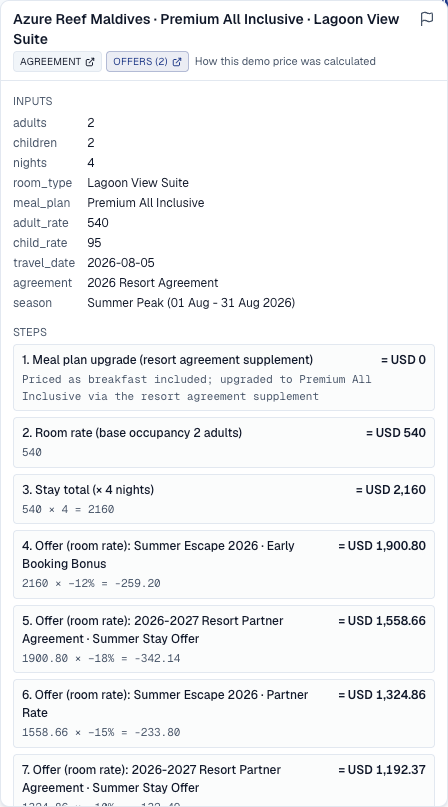
A price built by AI reading the contract, then computed exactly by the algorithm.
The takeaway
Yes, you can use ChatGPT for many things, and you should. Use it to write, summarize, and brainstorm. Just do not let a word-predictor be the final word on a price. For the number a customer pays, insist on a purpose-built, hybrid setup where AI reads and a proven algorithm does the exact math. Right tool, right job.