
Why Contracts Are the Real Bottleneck in Your Operation
Manual pricing, a flood of PDF offers, and a different format from every resort — a practical look at the work quietly slowing you down, and three ways out.
Most of the slow work in a DMC hides inside contract management: manual price calculation, endless PDF offers, and a new format from every resort. Here are three honest ways out.
It is 9 a.m. and three new offers have already landed in your inbox. Each one is a PDF, each is from a different resort, and each uses a layout you have to decode before you can quote a single night.
That quiet pile of paper is the real bottleneck in most operations. Not the quoting. Not the transfers. The bottleneck is contract management — keeping resort rate contracts current, reading every new offer, and turning it all into a price you can trust. This post is a practical, on-the-ground look at why that work is so heavy, and three honest ways out.
The work that never seems to end
Here is the uncomfortable truth: in most teams, manual price calculation is still done entirely by hand. Someone opens a contract, finds the right season and room type, adds the board, applies the markup, checks the offer, and works out a total. Then they do it again for the next room, the next night, the next inquiry.
It is slow, and it is risky. One wrong figure copied from an old PDF and you have quoted a rate that no longer exists. As the team at moonstride notes, DMC rates often "end up managed externally in spreadsheets, reintroduced manually at the quoting stage, and reconciled again at invoice time" — three chances to make the same mistake. You can read their honest breakdown of what DMCs need from software and why most systems fall short.
The cost is not just time. It is margin. Price a group a little low and you can lose the profit on the whole booking. Price too high or too slowly, and the agency simply asks someone faster.
Why contracts are so hard to keep current
The deeper problem is that contracts refuse to sit still. Almost every day, new offers arrive — an early-bird deal, a honeymoon perk, a stay-4-pay-3 window, a corrected rate sheet. Keeping all of that in sync inside any system is a constant, grinding challenge.
Managing contracts, as one hospitality finance leader puts it, "often remains a cumbersome process riddled with manual tasks, paperwork, and potential errors." That summary comes from a useful piece on AI and automation in hospitality contract management. Every one of those offers has to be read, understood, and entered before it is any use to you.
Then there is the format problem. Each resort writes its contracts its own way. One puts seasons in a table; another buries them in a paragraph. One lists supplements per person; another per room. Board basis, child policies, blackout dates, cancellation terms — same ideas, a hundred different layouts.
To handle them all cleanly, you would need one shared way to describe every agreement, offer, and package — a single "universal data model" that any contract can be poured into. Think of it like a standard shipping container: it does not matter what is inside, as long as it fits the same box so everything downstream can handle it the same way.
The catch is that this model keeps changing. Resorts invent new deal types every season, so the "box" has to grow to fit them. Building and maintaining software that keeps up with that moving target is genuinely hard.
Hours per contract, before you sell a thing
And none of this is free. Contract data entry is labour-intensive — we are talking hours per contract to get every season, rate, supplement, and rule typed in correctly. Multiply that by dozens of resorts and a fresh wave of offer management every week, and you have a full-time job that produces no quotes and no revenue on its own.
So how do you get out of it? There are really only three roads. Here is how they compare.
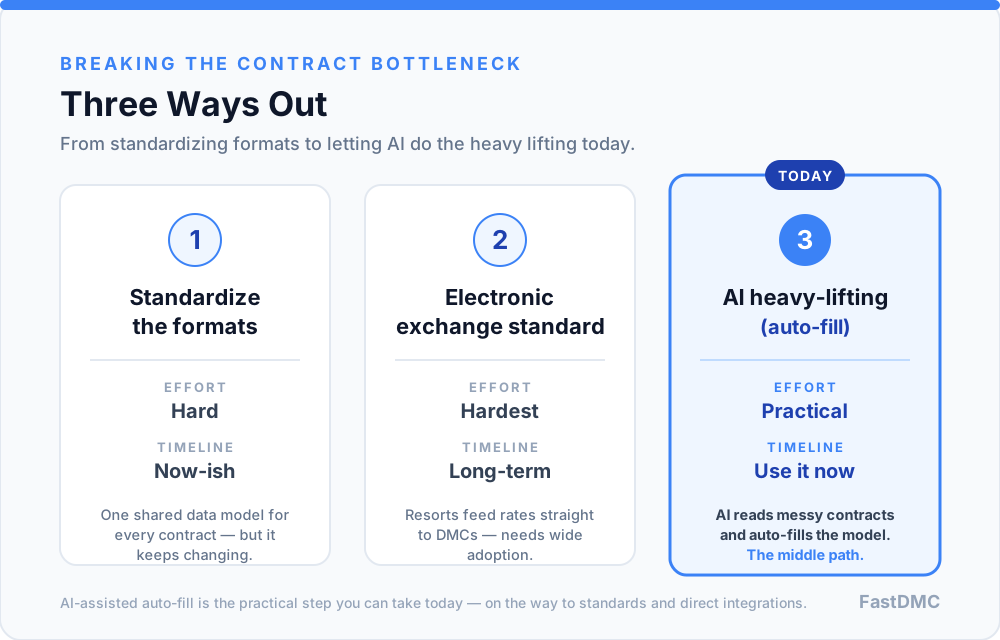
The three ways out of the contract bottleneck — and why AI-assisted auto-fill is the practical middle path today.
Way out 1: Standardize the formats
The first idea is to get everyone to write contracts the same way, so software providers can manage them cleanly. If every resort used the same headings and the same structure, a system could read them almost automatically.
It is a good instinct, and it is where the universal data model comes in. But building a truly comprehensive, universal model is itself very hard, and it is still problematic today. Rate rules are endlessly creative, and a model that covers all of them for one region may break the moment a new resort or a new deal type shows up. Useful, but not a finished answer.
Way out 2: A shared electronic exchange
The second idea is bigger: build an electronic format that resorts fill in and share directly with DMCs — no PDFs, no re-typing. The resort updates a rate once, and it flows straight into your system.
This is not science fiction. The travel industry has done it before through the OpenTravel Alliance, a non-profit that has built shared electronic message standards since 1999 so airlines, hotels, and their software can exchange information without manual re-keying.
The hard part is adoption. A standard only works when almost everyone uses it, and someone has to build and champion that standard first. This is the long-term play — the cleanest solution, but the slowest to arrive.
Way out 3: Let AI do the heavy lifting
The third road is the pragmatic middle ground you can use now. Instead of waiting for the world to standardize, you use AI to read the messy contracts you already receive and auto-fill your data model for you.
The technology is real and improving fast. Modern document processing combines OCR, computer vision, and large language models to extract and classify information from unstructured documents — exactly the kind of free-form paperwork a rate contract is. Tools like Microsoft's AI Builder already pull data from unstructured documents such as contracts after seeing only a handful of examples.
It is not magic. Because contract information is unstructured and disorganized, the AI has to be carefully fine-tuned for this specific job, and a human still checks the low-confidence bits. But it turns hours of typing into minutes of reviewing.
What you can do about it today
Even without new software, you can lighten the load:
- Pick one internal format. Decide how your team records seasons, rates, supplements, and rules, and force every incoming contract into that shape. Consistency alone kills half the errors.
- Log the offer date and expiry. Most bad quotes come from an old deal that quietly expired. A simple "valid until" column saves margin.
- Separate entry from checking. Have one person enter a contract and another verify it. Two sets of eyes catch the copy-paste mistakes that cost you a booking.
Where a tool like FastDMC fits
This is the exact bottleneck FastDMC is built to remove. It follows the practical middle path: AI reads your messy resort rate contracts and offers, and auto-fills a structured model, so travel contract automation becomes something you can actually run today — not a project you wait years for.
The aim is to keep moving up that ladder: from AI-assisted entry now, toward the wider standard and direct resort integrations later. You get the fast win immediately, without betting your operation on the whole industry changing first.
Contracts do not have to be the thing that slows you down. Get the reading and re-typing off your team's plate, keep your rate updates current without the daily grind, and you free your people to do what they are actually great at — building trips and serving agencies. That is the real prize on the other side of the bottleneck.
Further reading
- What DMCs actually need from their software — and why most systems fall short (moonstride)
- AI and automation in hospitality contract management (Hotel News Resource)
- OpenTravel Alliance — travel industry data exchange standards (Wikipedia)
- Automate data extraction from unstructured documents with generative AI (Amazon Web Services)
- Automate unstructured documents like contracts with AI Builder (Microsoft Power Platform)