
Why It Takes Months to Train a New Team Member and How to Fix It
Your pricing know-how lives in a few people's heads. When it's stuck there, every new hire starts from zero. Here's how to set it free.
New hires shadow your best people for months and still quote wrong. The reason is simple: your pricing knowledge lives in a few heads, not your systems. Here's how to capture it and speed up onboarding.
You hire someone bright and eager. Three months later, they still can't put together a clean quote without checking with a senior colleague. They shadow your best people, ask a hundred questions a week, and still send the odd price that makes you wince. If that is your reality, the problem is not the new hire. The problem is that all your pricing knowledge lives inside a few experienced heads, and staff training means slowly copying it from one brain to another.
This post is about why onboarding takes so long, what that costs you, and how to fix it — starting with things you can do this week, with no software at all.
The real skill is invisible
Think about what your best staffer actually knows. They know which resort suits a honeymoon versus a family of five with a toddler. They know which contract has a sneaky peak-season surcharge buried in the fine print. They know how to combine two offers so a package looks great without losing your margin. They know when a split stay needs a transfer buffer so nobody misses a seaplane.
None of that is written down. It is what experts call tacit knowledge is the personal, experience-based know-how that is learned by doing and rarely captured in any document. As the Nonaka–Takeuchi knowledge model explains, this kind of expertise is the hardest to share, precisely because the person holding it can do the job without ever having to explain it.
That is why your pricing knowledge is so valuable. It is also why it is so fragile.
What the slow ramp actually costs
New hires take a long time to become useful everywhere, not just in your office. According to research summarised by Deel, a new employee takes around 12 months to become fully productive in their role, and industry onboarding data shows most people need six to seven months just to feel settled. For roles that depend on complex judgement — like reading contracts and pricing stays that you are at the slow end of that range.
Every month of that ramp has a price. There is the salary you pay before the person pulls their weight. There is the senior staffer pulled off revenue work to answer questions and check quotes. And hiring itself is not cheap — SHRM benchmarks put the cost of bringing on a new employee at roughly $4,700 before you count the lost productivity while they learn.
Then there is the risk you cannot put a number on.
The single point of failure nobody talks about
Ask yourself a hard question. What happens the week your most experienced person is on holiday, off sick, or hands in their notice?
If the answer is "quoting slows to a crawl," you have what software teams call a bus factor of one — a single point of failure where one person holds knowledge nobody else has. When that person is unavailable, the work stalls. It is a real, board-level worry: one survey on key-person risk found most firms expect to lose a key person within three years, and most expect a heavy operational hit when it happens.
Your business should not depend on one person remembering the right answer.
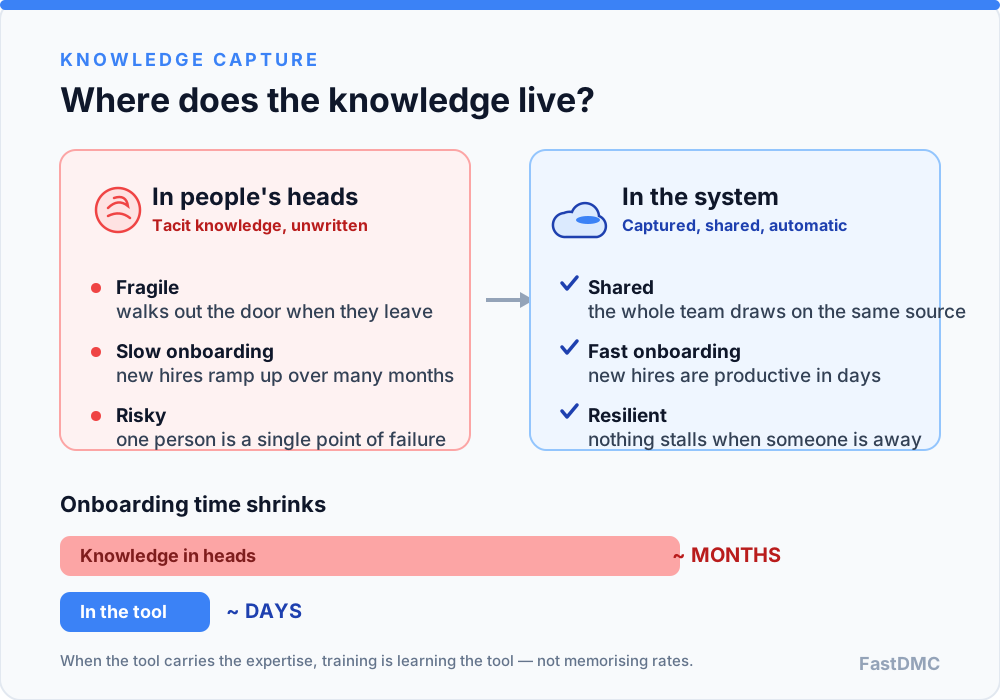 When knowledge lives in the system instead of a few heads, onboarding shrinks from months to days — and one person leaving stops being a crisis.
Fix it without buying anything: capture the knowledge
The good news is that you can start turning invisible know-how into something teachable today. The goal is knowledge capture — moving the important stuff out of memory and into a shared, written form your whole team can use. Here is where to begin.
Write resort profiles. For each resort you sell, capture who it suits, its strengths, and its quirks. "Great for honeymooners, adults-only, quiet. Weak Wi-Fi. Long seaplane transfer should be avoided for guests with small kids." One page per resort turns a veteran's gut feel into something a new hire can read.
Write down your pricing rules. The mark-up logic, the child policies, the seasonal surcharges, the rules for combining offers. If it lives in someone's head, write it as plain steps. These are your standard operating procedures. The point is that the business, not the person, owns the method.
Build a quoting checklist. A simple list a new hire runs through for every quote: check the contract dates, apply the right season, add transfers, confirm the child ages, double-check the total. Checklists catch the mistakes that experience usually prevents.
Capture the "why." This is the piece most teams skip. Do not just record which resort you picked and record why. "We chose this one over the cheaper option because the family wanted a house reef and a kids' club." The reasoning is the teachable part.
Do these four things and onboarding gets faster on its own. New staff stop guessing and start following a shared method.
Where a purpose-built tool takes over
Documents are a huge step up, but they still rely on people reading them, remembering them, and applying them correctly under time pressure. The next level is to put the knowledge inside the tool itself.
This is exactly what FastDMC is built for. You enter each contract once, and the system holds the rates, the seasons, and the rules. When an inquiry lands, it calculates the price for you and surfaces the best-fit resort options automatically, so the expertise is carried by the software, not recalled from memory. The judgement your veterans spent years building becomes something the tool applies every time, consistently.
That changes what training even means. Instead of memorising rates and rules, a new hire learns to use a tool that already knows them. They can produce a correct quote in days, not months, because they are not the source of the knowledge — the system is. And when someone is on holiday, nothing stalls. FastDMC becomes the shared memory that removes your single point of failure.
The takeaway
Slow onboarding is not a people problem. It is a knowledge problem. When your pricing know-how lives only in a few heads, every new hire starts from zero and your business rides on one person showing up. Start by writing it down: resort profiles, pricing rules, quoting checklists, and the reasoning behind your choices. That alone speeds up staff training and lowers your risk. When you are ready to make the knowledge automatic, a tool like FastDMC holds the logic for you, so your team's expertise finally belongs to the business.
Further reading
- The Nonaka–Takeuchi knowledge spiral: tacit vs explicit knowledge — MindTools
- Time to productivity: how long new hires take to ramp up — Deel
- Employee onboarding statistics and trends — AIHR
- The true cost of poor onboarding — Randstad
- Bus factor: the risk of unshared knowledge — Wikipedia
- Key-person risk: the hidden single point of failure — Beige Media