
Why Split-Stay Pricing Is So Hard: Three Methods, One Headache
Three legitimate ways to price a multi-room split stay — with worked examples — and why the right answer depends on which one the resort expects.
A split stay looks like a simple quote, but there are three valid ways to price it and they give different totals. Here is how each method works and why manual split-stay pricing quietly loses margin.

An agent emails you: their clients want two nights in a Beach Villa, then two nights in a Water Villa. Four nights, same resort, one booking. It sounds like a five-minute quote. Then you open the contract and realize there is no package for that exact combination so you have to build the price yourself. That is a split stay, and split-stay pricing is where confident quotes quietly go wrong.
A split stay is any trip where the guest spends part of their stay in one room category and part in another. Two nights Beach Villa plus two nights Water Villa. Or three nights in a garden room and two over the water. Resorts publish packages for whole stays in a single category, not for every mix a guest might dream up. So the price does not exist yet and you have to construct it. And here is the headache: there are three legitimate ways to construct it, and they can produce different totals for the exact same request.
This is not you being sloppy. It is a real feature of how resort contracts and package pricing work. Below are the three methods, each with the same guest request where 2 nights Beach Villa + 2 nights Water Villa. So you can see exactly where the numbers split apart.
The three methods at a glance
#MethodWhat it means1Extra Night Rate MethodPrice each room category using only its extra-night rate, then add transfers.2Package Proration MethodTake the full package price for each room category, divide by package nights, multiply by the actual split-stay nights.3Package Minus Extra Night MethodStart from the nearest package, then deduct extra-night value to reduce it to the required number of nights.
Each of these is a defensible way to answer the agent. Which one is correct is not a matter of taste. It depends on what the resort's contract says. That is the part that makes this hard.
Method 1: Extra Night Rate
The simplest approach is to ignore packages entirely and price each leg using the room's extra-night rate, then add the transfer.
Formula: (Beach Villa extra-night rate × Beach Villa nights) + (Water Villa extra-night rate × Water Villa nights) + transfer cost.
This method leans almost entirely on the extra-night rates in the contract. It is clean and easy to explain, and it works well when a resort actually prices split stays this way. The risk is that extra-night rates are often set as add-ons to a package, not as standalone nightly rates so using them alone can under- or over-price the stay depending on how that resort built its rate sheet.
Method 2: Package Proration
The second approach starts from the full package price and breaks it down to a per-night value, then rebuilds the stay from those nights.
Formula: room package price ÷ package nights × required nights.
Here is the worked example, for a resort where no split-stay package exists but a four-night package does:
- Beach Villa: 4-night package = 1000 → 1000 ÷ 4 = 250 per night → 250 × 2 = 500
- Water Villa: 4-night package = 1500 → 1500 ÷ 4 = 375 per night → 375 × 2 = 750
- Total = 500 + 750 = 1250
This treats the package price as the honest base and simply slices it into nights. It feels fair because it inherits whatever discount is already baked into the package. The catch is that packages are rarely priced evenly per night a four-night deal often front-loads value or includes fixed extras so a flat per-night average can drift from what the resort really intends.
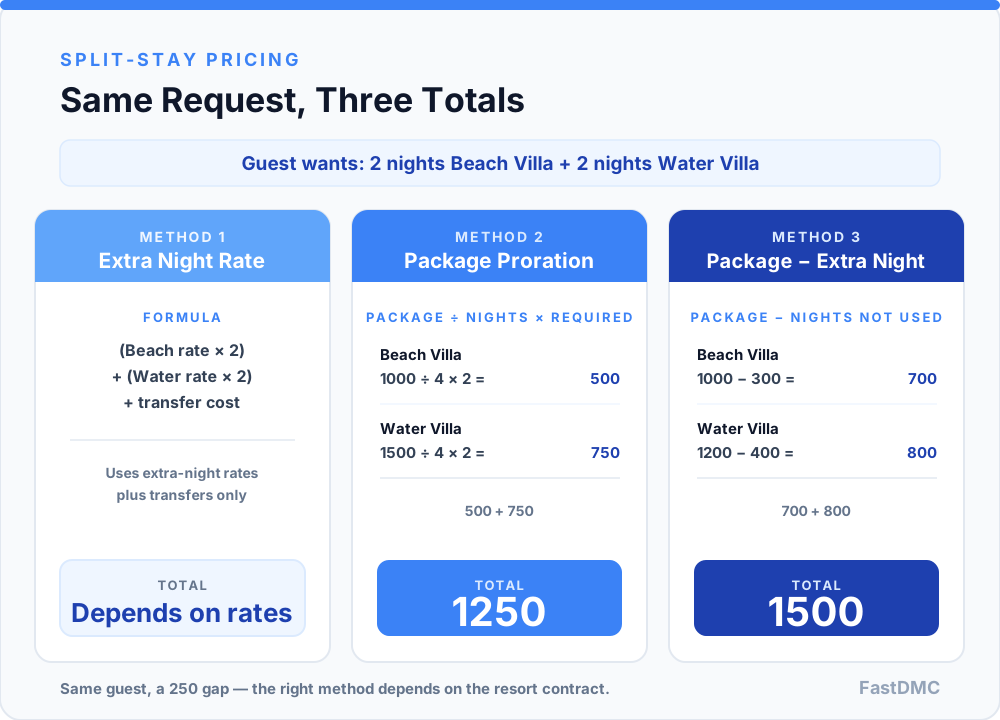 The same guest request, priced three ways and the totals do not match.
Method 3: Package Minus Extra Night
The third approach goes the other direction. Instead of building up from nights, you start from the nearest package and subtract the value of the nights you do not need.
Formula: package price − extra-night value for the nights not used.
Here is the worked example, for a resort where only three-night packages are available and the guest needs two nights in each room:
- Beach Villa: 3-night package = 1000, extra-night rate = 300 → 2-night cost = 1000 − 300 = 700
- Water Villa: 3-night package = 1200, extra-night rate = 400 → 2-night cost = 1200 − 400 = 800
- Total = 700 + 800 = 1500
This method respects the package as the anchor and treats extra nights as the adjustable part. It is common when a contract says "the package is the base, everything else flexes around it." But it needs both a package rate and an extra-night rate that line up, and it assumes an extra night is worth the same whether you are adding it or taking it away which is not always true.
Same request, different answers
Now look at what just happened. The exact same guest booking two nights Beach Villa, two nights Water Villa costs 1250 under Package Proration and 1500 under Package Minus Extra Night. That is a 250 gap on a single four-night booking, and neither number is "wrong." They are two correct answers to two different sets of contract rules.
Multiply that by dozens of resorts, each with its own rate structure and its own expectation of which method applies. Add the rate quotation pressure of an agent waiting on a live chat. This is exactly the kind of length-of-stay and package math that hotel pricing guides treat as a full discipline. When you do it by hand, the mistake is rarely a wild error. It is a quiet 250 here, a 180 there, on the wrong contract, and it comes straight out of your margin.
What you can do without any software
Even before you automate anything, a few habits help.
- Write the method into the contract notes. For each resort, record which of the three methods its rate sheet expects. Do not rederive it every time.
- Never average nights blindly. If a package bundles meals or a fixed transfer, proration will smear that value across nights it does not belong to. Separate fixed components before you divide.
- Keep extra-night rates and package rates in the same place. Method 3 falls apart the moment those two numbers live in different spreadsheets and one is out of date.
- Sanity-check the two totals. If proration and minus-extra-night are far apart for a resort, that gap is telling you something about how the contract is really built and which method to trust.
These are the same habits the better hotel pricing playbooks recommend for any length-of-stay pricing: know your base, know your adjustments, keep them consistent.
Where a purpose-built tool fits
Split-stay math is not hard because any one calculation is complex. It is hard because the right method changes per contract, and a human has to remember which one to use, pull the correct rates, and do the arithmetic under pressure, for every resort, every day.
That is precisely the kind of rule-based, repeatable work software is good at. FastDMC stores the pricing method alongside each resort's contract, so when a split-stay request comes in, it applies the correct method automatically where proration, minus-extra-night, or extra-night rate and returns one total you can trust. The split calculation runs the same way every time, whether it is your best quoter or your newest hire.
The takeaway
A split stay looks like a simple question with a simple answer. It is actually a simple question with three correct answers, and only one of them matches the resort you are quoting. Knowing the three methods lets you spot when a number looks off. Letting a system apply the right method per contract is how you stop losing 250 at a time without ever noticing.
Further reading
- A Guide to Hotel Rates: Rack Rates, BAR, Packages and More — AltexSoft
- Rate Quotation Training Tips for Reservations and Front Desk Staff — Doug Kennedy, Hospitality Net
- Hotel Pricing Strategy: 20 Tactics — Mews
- Important Hotel Pricing Strategies — Hotel Tech Report
- End-to-End Guide to Destination Management Software — CoaxSoft